
I am new to design
Build your mental model first
Start with why OOAD exists, then walk the roadmap. You need a stable vocabulary before patterns and architecture make sense.
Most hard software problems are not about syntax. They are about boundaries, responsibility, cohesion, dependency direction, changeability, and the cost of bad decisions over time. This vertical teaches those design skills in a deliberate sequence, using Java and a connected Order Management domain so the ideas stay practical rather than abstract.
We will start with why design matters, establish the learning roadmap, ground everything in object-oriented thinking, then progressively climb toward patterns, architecture styles, DDD, microservices, and concurrency. The goal is not pattern memorization. The goal is judgment.
Pattern learning becomes much easier when the families stay connected to responsibility, coupling, runtime behavior, and architecture decisions. JavaOmnibus keeps those layers together so you can move from principles to implementation without losing context.
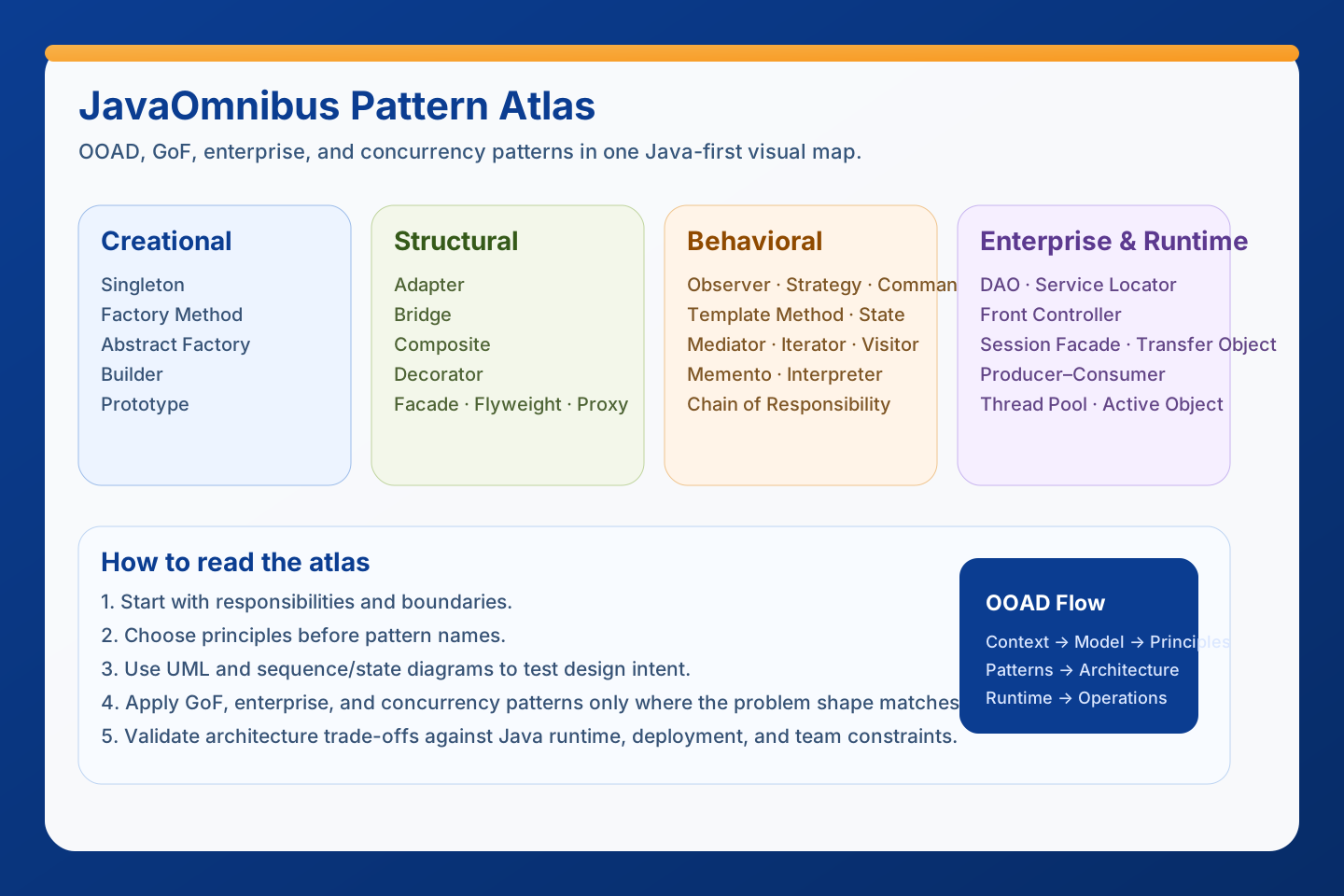
The GoF catalog is not separate from OOAD foundations. Composition, inheritance, encapsulation, abstraction, and polymorphism explain why each pattern has the shape it has. Use this as the fast bridge from a concept you are learning to the pattern family where that concept becomes concrete.
| OOAD concept | Main design pressure | Representative GoF patterns | Go deeper |
|---|---|---|---|
| Composition | Swap, stack, combine, or route behavior without subclass explosion. | Builder, Adapter, Bridge, Composite, Decorator, Proxy, Chain of Responsibility, Observer, State, Strategy | Composition details |
| Inheritance | Vary a stable parent contract or algorithm skeleton through subclass specialization. | Factory Method, Interpreter, Template Method | Inheritance details |
| Encapsulation | Hide state, protect invariants, simplify subsystems, or externalize state safely. | Singleton, Facade, Flyweight, Command, Iterator, Memento, Mediator | Encapsulation details |
| Abstraction | Depend on contracts, roles, and simplified surfaces instead of concrete implementation detail. | Abstract Factory, Factory Method, Bridge, Facade; supports most interface-driven patterns | Abstraction details |
| Polymorphism | Let runtime behavior vary behind a stable call instead of branching everywhere. | Prototype, Visitor; supports Strategy, State, Command, Observer, Adapter, Decorator | Polymorphism details |
Start with why OOAD exists, then walk the roadmap. You need a stable vocabulary before patterns and architecture make sense.
Even experienced developers benefit from grounding pattern choices in responsibility, coupling, and failure modes first.
Use this vertical to reason from domain boundaries upward: model first, patterns second, architecture trade-offs after that.
OOP foundations, design principles, OO analysis and design process, UML, anti-patterns, GoF patterns, DI/IoC, J2EE/Jakarta EE patterns, architectural styles, DDD, microservices, concurrency, and reference material.
In the Order Management domain, a good Order model knows what it can do, what invariants it must
protect, and what it should not expose. The OOP foundations section will move from abstraction and
encapsulation into composition, polymorphism, and the shape of healthy object relationships.
SOLID, GRASP, coupling, cohesion, and Tell-Don't-Ask are not academic checklists. They are pressure-tested heuristics for making changes safer. In a Java commerce system, they shape whether payment logic sprawls across controllers, services, and repositories or lives behind a small number of coherent abstractions.
We now walk from use cases and domain modelling into responsibility-driven design and system design walkthroughs using checkout, payment authorization, stock reservation, and shipment coordination as one connected story.
The UML section now focuses on developer-useful diagrams: class, sequence, state, package, component, and deployment. Each page will explain what question that diagram answers in a real Java system rather than turning notation into trivia.
God classes, anemic models, primitive obsession, feature envy, and shotgun surgery will be taught as recurring failure modes you can spot in Java code reviews and architecture discussions, not just as labels.
Creational, structural, and behavioral patterns are being taught around the problems they solve in Java, not as a memorization list. The full GoF section is now live.
The DI/IoC batch is now live and shows how explicit dependencies, injection styles, containers, and Spring wiring turn design principles into production architecture.
The J2EE / Jakarta EE batch is now live and translates the enterprise pattern catalog into modern Java, Spring, and layered system design.
The Architectural Styles batch is now live and covers decision criteria, trade-offs, layered systems, hexagonal boundaries, clean architecture, event-driven design, and architecture comparisons.
The DDD batch is now live and covers strategic and tactical design, including ubiquitous language, bounded contexts, aggregates, domain events, and rich domain modeling.
The Microservices batch is now live and connects bounded contexts, service decomposition, data consistency, resilience, and migration patterns back to the same Java order-management domain.
The Concurrency batch is now live and covers threading bug families, monitor objects, active objects, thread pools, producer-consumer pipelines, and Reactor versus Proactor execution models.
The final batch is now live and includes pattern cheatsheets, architecture comparison pages, Java and Spring mappings, modeling distinctions, and curated source-code study packs.
Customer, Cart, Order, Payment, Shipment, and Notification will appear across the vertical so ideas build on each other instead of resetting every page.
No. You need to understand responsibility, coupling, cohesion, and boundaries first. Patterns become far more useful once you can recognize the problem shape they address.
No. This vertical is for Java developers who want better judgment in everyday design work, from domain modelling and package boundaries to framework decisions and long-term maintainability.
No. We will use Spring where it helps explain IoC, layering, application services, and integration boundaries, but the pages are not framework-dependent tutorials.
Because continuity reduces cognitive reset. When the domain stays stable, you can focus on design choices rather than re-learning the business context on every page.
Read why OOAD exists before learning the vocabulary. It creates the motivation for everything else.
Use the roadmap if you already know classes and interfaces but want a more systematic progression into architecture.
If you are maintaining real Java systems, design failures are often the fastest route to insight and refactoring priorities.
Use the roadmap as your primary spine. It was designed to prevent premature jumping into patterns before the design vocabulary is in place.
See how OOAD changes a Java order-management design in concrete terms before you study principles or diagrams.
Start with the recurring failures that cause teams to redesign systems later at much higher cost.